Quick answer
Fish a small section of mixed grass and sand during moving water.
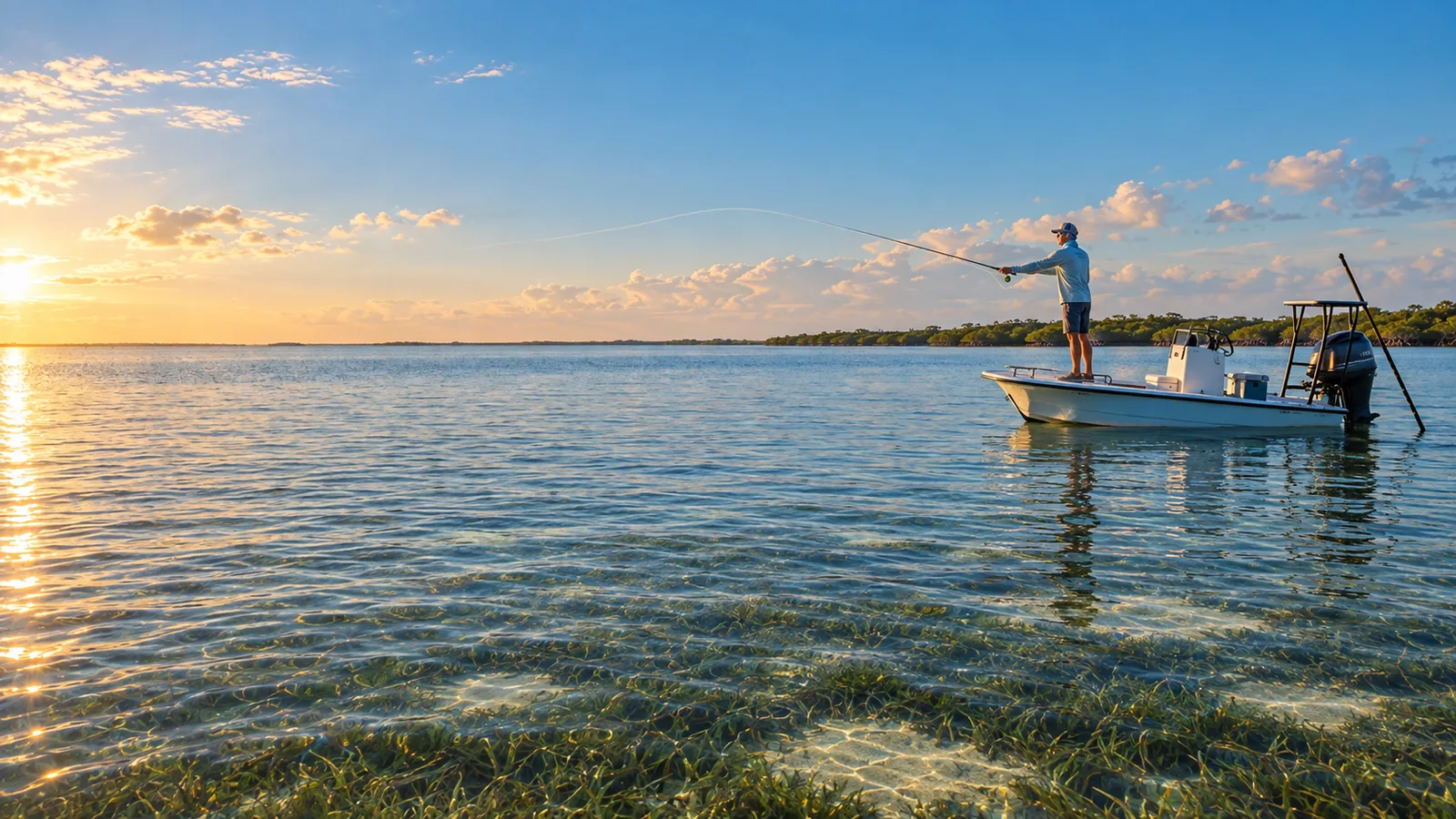
For a first Tampa Bay grass-flat trout trip, choose a flat with healthy submerged grass, visible sand holes and a nearby edge or depth change. Begin with a 3- to 4-inch paddletail, make long casts while drifting quietly, and move after 20 to 30 minutes if the flat shows no bait, birds, strikes or fish.
That is the complete starting pattern. The rest of this guide explains how to choose the flat, rig the tackle and make a useful adjustment instead of changing everything after five empty casts.
Choose the water
Look for differences inside the grass, not just a large green patch.
Seagrass is valuable habitat and nursery structure throughout Tampa Bay. For an angler, the most useful flat is not necessarily the largest one. A smaller area with sand openings, an outer edge, slightly darker water or a nearby channel gives trout multiple ways to feed and change depth.
Grass beside sand
Cast across the transition so the lure moves from one bottom type to the other. The visible edge gives you a repeatable target.
The outside edge
When the flat feels empty, slide toward the nearest depth change rather than making a long run to unrelated water.
Life on the flat
Bait flicks, nervous surface water, feeding birds and clean grass are reasons to slow down. Their absence is a reason to keep searching.
Tampa Bay Estuary Program notes that trout use seagrass beds in moderate water temperatures and deeper water adjacent to the beds during the warmest and coolest periods. Treat that as a seasonal planning clue, not a same-day catch guarantee.
Three practical setups
Carry options that change presentation without changing the whole outfit.
Paddletail search bait
Use a 7-foot medium spinning rod, a 2500- to 3000-size reel, 10- to 15-pound braid and 15- to 20-pound fluorocarbon leader. Start with a 3- to 4-inch paddletail on a 1/8- or 1/4-ounce jighead, choosing the lightest weight that lets you feel and control the lure without constantly burying it in grass.
Popping-cork presentation
Hang a live shrimp or suitable artificial below a popping cork when wind, chop or stained water makes a little sound useful. Adjust the leader so the bait travels above the grass instead of dragging through it.
Low-light topwater
Use a small walking plug during calm early or late periods. Pause after a missed strike instead of immediately ripping the lure away, then switch back to a subsurface lure as light and surface disturbance increase.
Change one variable: retrieve speed, lure depth, color contrast or the part of the flat you are covering. You learn nothing when you replace the lure, leader, location and retrieve simultaneously.
A 30-minute search plan
Give one small piece of water a fair test, then make a reasoned move.
- 00–10Cross the grass.
Fan-cast the paddletail across grass and sand transitions. Keep the boat or kayak quiet and record the depth where the lure begins touching vegetation.
- 10–20Work the edge.
Move toward the nearest outside edge, pothole line or subtle drop. Slow the retrieve enough to stay close to the bottom without collecting grass every cast.
- 20–30Test the contrast.
Try the popping cork or topwater when conditions fit. If the area still shows no bait, birds, strikes or fish, move to the next similar feature rather than restarting randomly.
This search is intentionally short. It forces a beginner to observe the flat, test a repeatable pattern and move for a reason instead of spending the whole morning on one empty patch.
Conditions first
Use tide, wind and temperature to choose where the plan begins.
- Water movement
- Check the NOAA station nearest the section of Tampa Bay you will actually fish. The bay has multiple stations, so a prediction at one end should not be treated as exact timing everywhere.
- Wind
- A manageable drift helps cover water. Strong wind against current can make boat control, lure contact and the ride home harder, so select a protected alternative before launching.
- Temperature
- During moderate periods, begin on the grass. During the hottest or coldest stretches, include adjacent deeper water in the plan rather than assuming the shallowest section will hold fish all day.
Fish the habitat without damaging it
A productive grass flat is not a shortcut.
FWC identifies propeller scarring, grounding, anchoring and other boating activity as threats to seagrass. Stay in marked channels when the water is unfamiliar, avoid running across shallow vegetation, and slow down before the bottom becomes uncertain.
- Know the boat’s operating depth before entering shallow water.
- Use a push pole, paddle or trolling motor when depth is uncertain.
- Anchor on bare sand, not in submerged grass.
- If you ground, stop the engine rather than powering through the flat.
- Follow posted manatee, idle-speed, minimum-wake and habitat-protection zones.
Rules and source trail
Verify the rule for the exact water before keeping a fish.
FWC currently lists Tampa Bay Region spotted seatrout as open year-round, with a 15- to 19-inch slot and a three-fish daily bag limit. One fish over 19 inches may be possessed per vessel, or per shore angler, and counts toward the bag limit. Region boundaries and additional gear and for-hire rules apply.
This article has passed its scheduled rules-review date. The prior rules snapshot is hidden until a human verifies it again. Use the current FWC link below before fishing.
Regulations can change. Do not use a saved screenshot, search excerpt or this article as the final authority on harvest.
- FWC spotted seatrout regulations
- FWC seagrass habitat and protection FAQ
- FWC boating regulations and seagrass awareness
- NOAA Tampa Bay water-level stations
- Tampa Bay Estuary Program bay and habitat guide
Source trail reviewed September 24, 2026. Next scheduled review: December 24, 2026.
Quick questions
Tampa Bay grass-flat trout FAQ
Where should a new angler start?
Choose a healthy grass flat with sand holes, an edge or nearby deeper water. Cover one manageable section during moving water before changing locations.
What is the simplest lure to begin with?
A 3- to 4-inch paddletail on a light jighead is versatile and lets you cover several depths. Use the lightest jighead that maintains control without constantly collecting grass.
Which tide station should I use?
Use the NOAA station nearest your actual fishing zone. Tampa Bay is too large to assume one station represents every shoreline and bay segment precisely.
What if I cannot identify a safe route across the flat?
Do not run it. Stay in marked water, slow down, and use a trolling motor, paddle or push pole only where the boat has adequate depth.